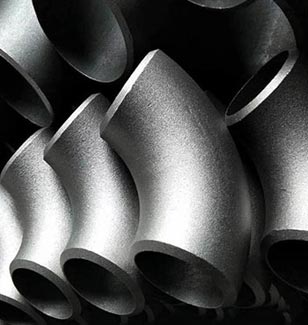
- SS Buttweld Pipe Fitting
- SS Elbow
- Stainless Steel Tee

Stainless Steel Buttweld Pipe Fittings
While SS Fitting in general envelope many components, they can be in turn be segregated according to the function they perform. For instance, fittings that change the size of the pipe is a category which takes into account fittings such as reducing tees or SS pipe reducer.
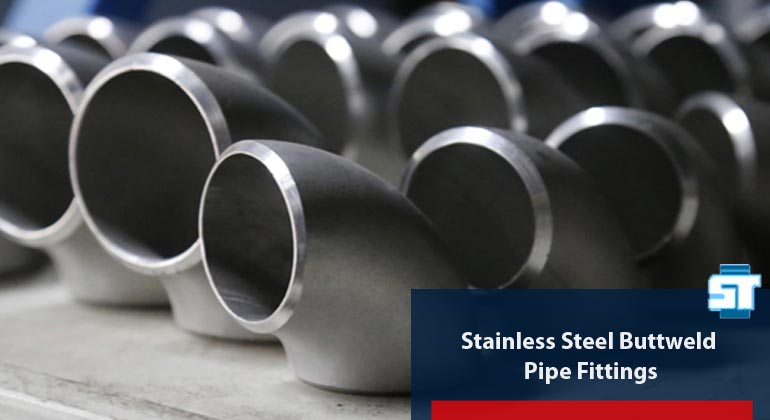
On the other hand, those fittings that facilitate the change in direction can be put under one category. These fittings include tees, elbows or crosses. Usually, SS tee fitting are a short pipe with a lateral outlet on one side and has two 90 degree angled outlets branched on the opposite side, thus forming a ‘T’ shaped fitting. While fitting that stop the flow of media include caps. And couplings are fitting that can be attached to different components. ss weld fitting are high integrity connections that have the ability to offer good tensile strength and tend to be highly reliable. Two of the more common austenitic grades i.e. alloy 304 and alloy 316 come highly recommended by SS pipe fitting manufacturers in India. Apart from these two alloys, ss elbow manufacturers are able to customize the production of these fitting in different alloys in varying sizes, depending on the requirements of our clients.
Specification of Stainless Steel Buttweld Pipe Fittings
| Specifications | Stainless Steel Buttweld Pipe Fittings |
|---|---|
| Welded Fitting Pressure Rating Classes | Pressure Rating buttweld end-2000lb, 3000lb, 6000lbs |
| ASTM A403 Elbow Size Range | 1/8 Inches TO 4 Inches |
| SS Seamless Fitting Type | DN 15 To DN 1200 |
Stainless Steel Elbow Sizes And Schedules
| Schedules | Schedules 10S To 80S |
| Buttweld Fitting Types | 90º Long radius, 90º Short radius, 45º Elbows, Concentric & Eccentric Reducers, Tees, Reducing Tees and Stub Ends Fitting |
| Available Sizes | 1/2 Inch to 12inch |
Dimension Table of ASTM A403 Elbow
| DIN | Schedule 105 | Schedule 405 | Schedule 805 | ||||||
| 90 Degree Elbow | 45 Degree Elbow | Equal Tee | 90 Degree Elbow | 45 Degree Elbow | Equal Tee | 90 Degree Elbow | 45 Degree Elbow | Equal Tee | |
| 8 | 0.02 | 0.01 | 0.03 | 0.03 | 0.02 | 0.06 | 0.04 | 0.03 | 0.07 |
| 10 | 0.03 | 0.02 | 0.05 | 0.03 | 0.02 | 0.03 | 0.06 | 0.04 | 0.09 |
| 15 | 0.06 | 0.03 | 0.09 | 0.08 | 0.04 | 0.10 | 0.10 | 0.05 | 0.14 |
| 20 | 0.07 | 0.03 | 0.13 | 0.08 | 0.04 | 0.17 | 0.11 | 0.05 | 0.20 |
| 25 | 0.14 | 0.08 | 0.28 | 0.15 | 0.11 | 0.29 | 0.22 | 0.14 | 0.38 |
| 32 | 0.23 | 0.11 | 0.49 | 0.26 | 017 | 0.59 | 0.40 | 0.23 | 0.68 |
| 40 | 0.30 | 0.17 | 0.68 | 0.40 | 0.23 | 0.86 | 0.51 | 0.29 | 1.02 |
| 50 | 0.50 | 0.25 | 0.85 | 0.70 | 0.40 | 1.28 | 0.91 | 0.59 | 1.59 |
| 65 | 0.85 | 0.48 | At | 1.40 | 0.77 | 2.19 | 1.81 | 0.99 | 3.13 |
| 80 | 1.25 | 0.63 | 1.77 | 2.20 | 1.08 | 3.31 | 2.97 | 1.50 | 4.45 |
| 90 | 1.70 | 0.75 | 2.67 | 2.83 | 1.42 | 4.08 | 4.00 | 2.00 | 5.44 |
| 100 | 2.10 | 1.08 | 3.46 | 447 | 2.09 | 5.27 | 6.18 | 281 | 771 |
| 150 | 5.45 | 2.72 | 8.07 | 10.89 | 5.44 | 10.99 | 16.32 | 8.16 | 13.61 |
| 200 | 10.20 | 5.33 | 15.65 | 21.54 | 10.77 | 20.91 | 33.11 | 16.56 | 28.12 |
| 250 | 18.15 | 9.75 | 26.46 | 38.56 | 19.27 | 35.38 | 51.71 | 25.86 | 49.90 |
| 300 | 25.80 | 13.62 | 39.46 | 59.42 | 29.71 | 62.14 | 79.38 | 39.69 | 83.91 |
Wide stock of SS Seamless Fittings
- ASTM A403 Elbow
- SS Seamless Fitting
- SS Weld Fitting
Difference between ss buttweld fittings and seamless fittings
Seamless fittings as a whole have a much smoother appearance unlike buttweld ones, where there is an appearance of a line on the surface of its fittings. Moreover, since seamless fittings are constructed by extrusion, they tend to be more uniform in their size, weight and dimensions. Seamless fittings are also lighter in weight and are thinner in comparison to stainless steel buttweld fittings.
Another difference noted between both buttweld and seamless fittings is the content of carbon. Usually, those stainless steels that are to be buttwelded use low carbon versions of stainless steels in order to prevent sensitization by grain boundary precipitates. For instance, While many individuals do not consider using alloy grade 304L or stainless steel grade 316L for applications due to its structural weakness; it is important to note that both stainless steel grades 316L as well as 304L have added contents of nitrogen in their alloy. In austenitic stainless steel alloys such as 316L and 304L, adding nitrogen not only improves its yield strength but also the buttweld fittings ability to withstand pitting and crevice corrosion.
At elevated pressure conditions, buttweld fittings have a tendency to crack, unlike stainless steel seamless fittings which can withstand a pressure 20% more than buttweld fittings. With regards to the cost of these fittings, buttwelded fittings are a cheaper alternative as compared to seamless fittings. Hence those factories that have a low pressure working system often choose using butt-weld fittings because of its economical value.